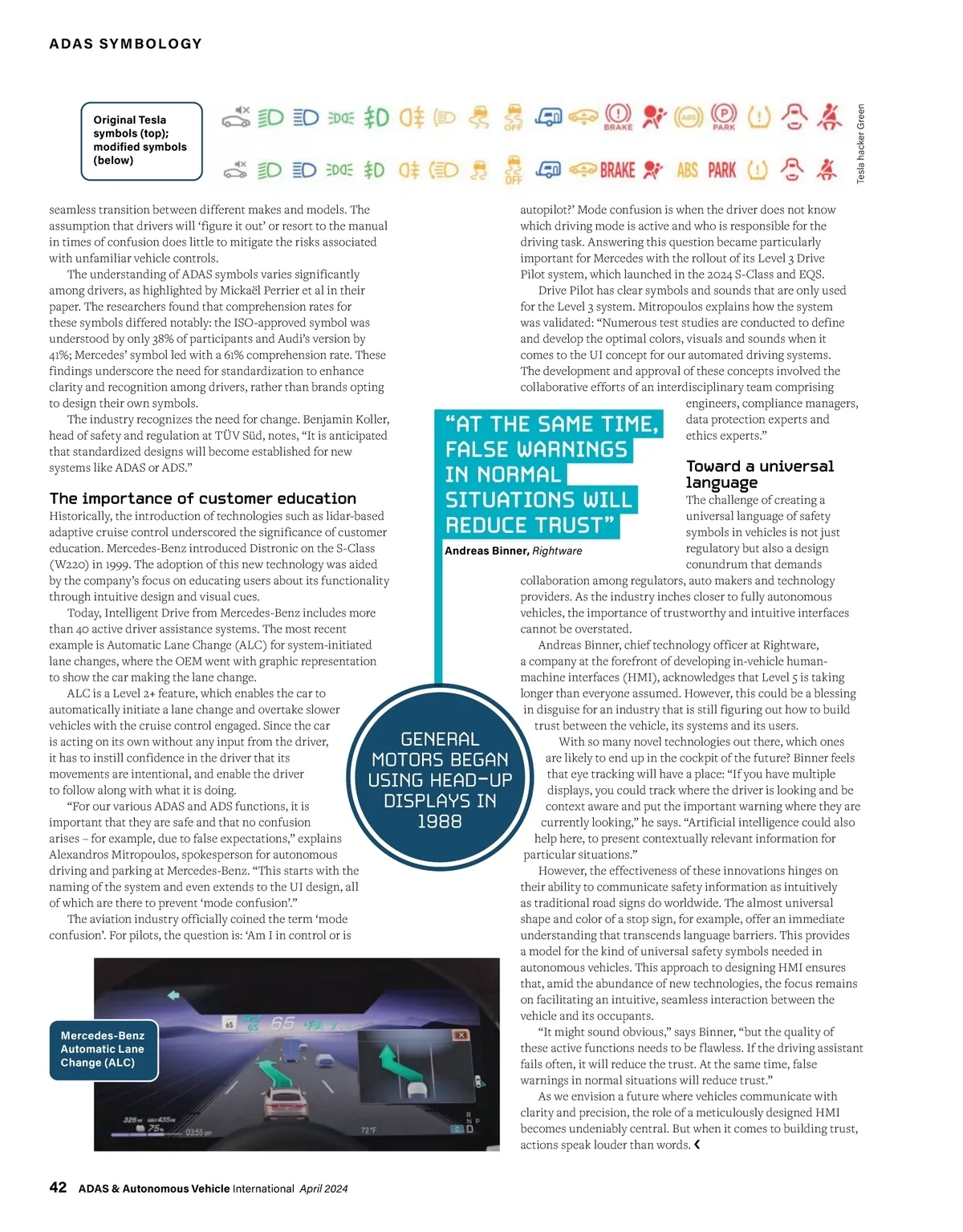
ADAS SYMBOLOGY Original Tesla symbols (top); modified symbols (below) seamless transition between different makes and models. The assumption that drivers will ‘figure it out’ or resort to the manual in times of confusion does little to mitigate the risks associated with unfamiliar vehicle controls. The understanding of ADAS symbols varies significantly among drivers, as highlighted by Mickaël Perrier et al in their paper. The researchers found that comprehension rates for these symbols differed notably: the ISO-approved symbol was understood by only 38% of participants and Audi’s version by 41%; Mercedes’ symbol led with a 61% comprehension rate. These findings underscore the need for standardization to enhance clarity and recognition among drivers, rather than brands opting to design their own symbols. The industry recognizes the need for change. Benjamin Koller, head of safety and regulation at TÜV Süd, notes, “It is anticipated that standardized designs will become established for new systems like ADAS or ADS.” The importance of customer education The challenge of creating a Historically, the introduction of technologies such as lidar-based universal language of safety adaptive cruise control underscored the significance of customer symbols in vehicles is not just education. Mercedes-Benz introduced Distronic on the S-Class regulatory but also a design Andreas Binner, Rightware (W220) in 1999. The adoption of this new technology was aided conundrum that demands by the company’s focus on educating users about its functionality collaboration among regulators, auto makers and technology through intuitive design and visual cues. providers. As the industry inches closer to fully autonomous Today, Intelligent Drive from Mercedes-Benz includes more vehicles, the importance of trustworthy and intuitive interfaces than 40 active driver assistance systems. The most recent cannot be overstated. example is Automatic Lane Change (ALC) for system-initiated Andreas Binner, chief technology officer at Rightware, lane changes, where the OEM went with graphic representation a company at the forefront of developing in-vehicle human-to show the car making the lane change. machine interfaces (HMI), acknowledges that Level 5 is taking ALC is a Level 2+ feature, which enables the car to longer than everyone assumed. However, this could be a blessing automatically initiate a lane change and overtake slower in disguise for an industry that is still figuring out how to build vehicles with the cruise control engaged. Since the car trust between the vehicle, its systems and its users. GENERAL is acting on its own without any input from the driver, With so many novel technologies out there, which ones it has to instill confidence in the driver that its are likely to end up in the cockpit of the future? Binner feels MOTORS BEGAN movements are intentional, and enable the driver that eye tracking will have a place: “If you have multiple USING HEAD-UP to follow along with what it is doing. displays, you could track where the driver is looking and be DISPLAYS IN “For our various ADAS and ADS functions, it is context aware and put the important warning where they are important that they are safe and that no confusion currently looking,” he says. “Artificial intelligence could also 1988 arises – for example, due to false expectations,” explains help here, to present contextually relevant information for Alexandros Mitropoulos, spokesperson for autonomous particular situations.” driving and parking at Mercedes-Benz. “This starts with the However, the effectiveness of these innovations hinges on naming of the system and even extends to the UI design, all their ability to communicate safety information as intuitively of which are there to prevent ‘mode confusion’.” as traditional road signs do worldwide. The almost universal The aviation industry officially coined the term ‘mode shape and color of a stop sign, for example, offer an immediate confusion’. For pilots, the question is: ‘Am I in control or is understanding that transcends language barriers. This provides a model for the kind of universal safety symbols needed in autonomous vehicles. This approach to designing HMI ensures that, amid the abundance of new technologies, the focus remains on facilitating an intuitive, seamless interaction between the vehicle and its occupants. “It might sound obvious,” says Binner, “but the quality of Mercedes-Benz these active functions needs to be flawless. If the driving assistant Automatic Lane Change (ALC) fails often, it will reduce the trust. At the same time, false warnings in normal situations will reduce trust.” As we envision a future where vehicles communicate with clarity and precision, the role of a meticulously designed HMI becomes undeniably central. But when it comes to building trust, actions speak louder than words. “AT THE SAME TIME, FALSE WARNINGS IN NORMAL SITUATIONS WILL REDUCE TRUST” autopilot?’ Mode confusion is when the driver does not know which driving mode is active and who is responsible for the driving task. Answering this question became particularly important for Mercedes with the rollout of its Level 3 Drive Pilot system, which launched in the 2024 S-Class and EQS. Drive Pilot has clear symbols and sounds that are only used for the Level 3 system. Mitropoulos explains how the system was validated: “Numerous test studies are conducted to define and develop the optimal colors, visuals and sounds when it comes to the UI concept for our automated driving systems. The development and approval of these concepts involved the collaborative efforts of an interdisciplinary team comprising engineers, compliance managers, data protection experts and ethics experts.” Toward a universal language 42 ADAS & Autonomous Vehicle International April 2024 Tesla hacker Green
ADAS & Autonomous Vehicle International ADAS & Autonomous Vehicle International April 2024: Page 42